


The Blog
The Blog
Go behind the scenes of my multi-million view digital magazine empire with tips to help you start your own.
Read Now →

August 2, 2026
Gen Z is Bringing Magazines Back— Here’s What the Data Actually Says
Everyone said magazines were dead. Gen Z didn’t get the memo.
I’ve been in this industry for 15 years and I have watched the “magazines are dead” narrative creep into every media conversation for about that long. It was always an obvious story. Digital killed attention spans, social media gutted advertising budgets, nobody wanted to pay for magazines anymore.
Except none of that was ever really true. Now, the data is catching up to what those of us who never left already knew.
Enter Gen Z. The generation raised entirely on TikTok, Instagram, and YouTube is leading one of the most unexpected media comebacks in recent history, with the numbers almost impossible to ignore.
89% of Americans under 25 read at least one magazine in the last six months
Print and digital magazines combined. That’s not a rounding error or a niche demographic. That’s nearly nine in ten young adults actively choosing to engage with magazine content in a world where they have infinite other options competing for their attention.
Let’s sit with that for a moment. The generation with the shortest alleged attention span, the generation that grew up swiping and scrolling, is reading magazines at a rate that should make every media executive who abandoned the format at least let out a massive sigh.
They’re not stumbling across magazines accidentally either; they’re seeking them out.
71% of consumers say magazines feel more authentic than social media content
This is the stat that explains it all.
We are living through an authenticity crisis on social media. Our feeds are flooded with AI-generated content, sponsored posts disguised as genuine recommendations, and content designed to keep you scrolling rather than actually serve you. People can feel it even when they can’t articulate it. Something about their feed feels hollow and manufactured. AI content is a new version of vanilla nobody wants.
A magazine is the opposite of that. Every article has a byline. Every photo is credited to a photographer. There is a human being— AKA an editor like me—who decided what went in and what stayed out. That curation signals something that no algorithm can replicate: someone made this for you, specifically, with intention.
Gen Z has grown up in the most saturated media environment in history. They are enormously sensitive to the difference between content that was created and content that was generated. And they are choosing the former.
2024 was officially declared “The Year of the Relaunch” by magazine analyst Samir Husni
Saveur came back to print after dropping it in 2020. SPIN published its first print issue since 2012— a twelve year gap. LIFE magazine, one of the most iconic publications of the last century, announced its return to newsstands after closing its print edition in 2008. Field & Stream, Businessweek— they all came back.
These aren’t scrappy indie titles making a comeback either. These are major publishers with resources and data, and in many cases, even shareholders they need to answer to. They left print because the numbers told them to. They came back because the numbers changed.
Publishers don’t make decisions like this out of nostalgia. They make them because the audience is there and it turns out the audience never really left. It just waited.
W Magazine just launched WYouth and it’s becoming a trend
In early 2026, W Magazine announced WYouth, a teen-focused sister publication launching later this year with Sofia Coppola and her 15-year-old daughter Cosima Croquet as contributing editors. When a Gen Z trend expert was asked about it, she called it “the fourth teen magazine I’ve heard in the works in the last month alone.”
Four new teen magazines.
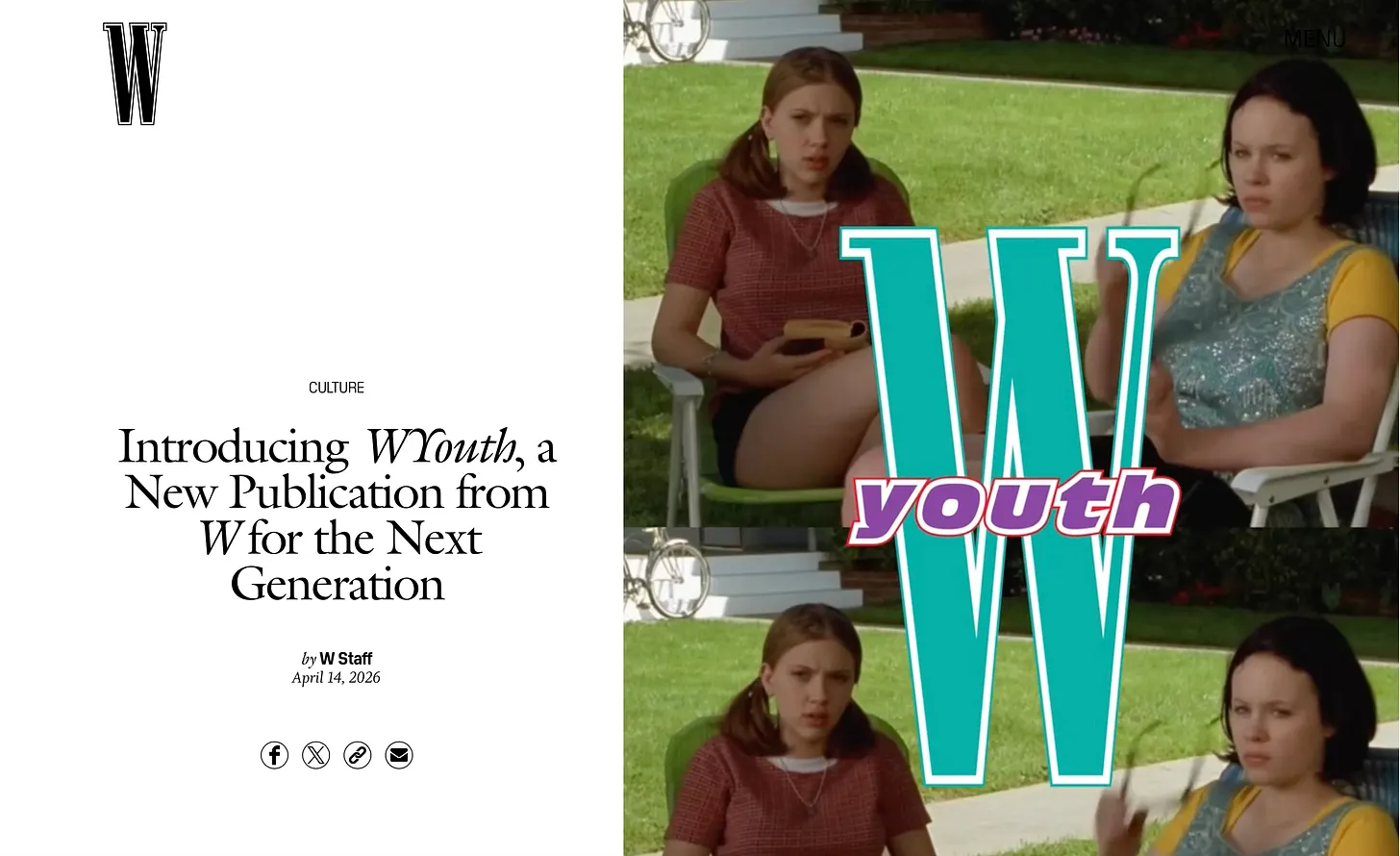
This is a signal. The industry is responding to demand that has been building quietly for years and is now impossible to ignore. i-D magazine returned to shelves in 2025 driven specifically by Gen Z demand. The Atlantic increased its print editions.
“For the first time in more than two decades, The Atlantic will once again publish monthly, beginning with the January 2025 issue (it has published 10 issues a year since the early 2000s),” reads their website, citing a historic year of subscription growth and return to profitability.
Everywhere you look, the story is the same. Magazines are back and young people are leading the charge.
Fortune called it “the analog economy,” Gary Vee called it the barbell world
The deeper cultural story here is bigger than magazines. Gen Z is buying vinyl records at rates not seen since the 1980s. Live concert attendance is climbing. Independent bookstores are becoming token destinations once again. The kids are picking up cameras again.
There is a through line connecting all of it. In a world that is becoming increasingly AI, the things that are unmistakably human have become more valuable, not less.
A magazine—digital or print—is one of those things. It is curated by a human, written by humans, photographed by humans, and edited by a human with a specific point of view. In a world drowning in AI-generated everything, that is increasingly rare.
Gary Vee put it simply: “As the world goes more AI, analog will explode.”
He was talking about the barbell effect, with extreme technology on one side and old school human experience on the other. Magazines sit firmly on the human side of that barbell. And Gen Z, more than any generation before them, knows which side they want to be on.
So what does this mean for you?
If you have been sitting on a magazine idea—local, niche, digital, print, whatever has been living rent-free in your head—the data is telling you something.
The audience is there. It has never been younger or bigger. The appetite for something curated, intentional, and human has never been stronger. The barrier to entry has never been lower. And the generation that is going to be reading magazines for the next fifty years is already looking for publications that speak to them.
You don’t need a big office or a publishing house or a print run of ten thousand. You need a point of view, a niche, and the right strategy.
That is exactly what I teach inside The Editor Academy and if you are ready to stop sitting on the idea and actually build something, I would love to help you do it.

